Part Three: Disruption, Survival, and the Reconstruction Carryover
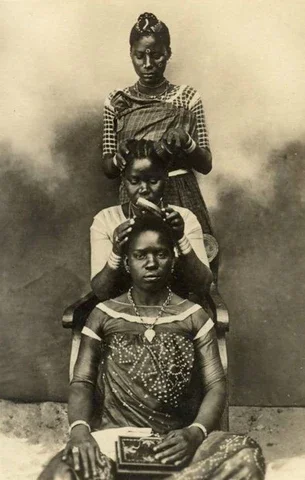
Before hair care became something judged, regulated, or debated, it became something interrupted.
This part of the story is not about preference or beauty. It is about what happens when a cultural system is broken, and people are forced to rebuild with almost nothing.
To understand modern Black hair practices honestly, we have to sit in this moment long enough to see how survival replaced choice — and how survival later became routine.
Disruption Under Enslavement
One of the earliest acts of control imposed on enslaved Africans was the removal or severe cutting of hair.
This was not incidental.
Hair held information — identity, lineage, status, spiritual meaning. Removing it stripped people of recognizable markers and made them harder to identify to one another and to themselves. It severed continuity. It flattened difference.
Hair was no longer something you carried from your community.
It became something managed by someone else.
Traditional tools disappeared. Oils, clays, combs, time, and communal grooming spaces were no longer accessible. Privacy vanished. Surveillance replaced care.
Hair stopped functioning as a cultural language and became another site of domination.
Survival Hair Care Under Enslavement
Immediately following disruption came improvisation.
People still had hair. They still had scalps. They still had bodies doing relentless labor in harsh conditions. Something had to be done — not to express identity, but to reduce harm.
Hair care shifted into survival mode.
With limited access to water and no access to preferred materials, people used what was available:
animal fats and grease to reduce friction and dryness
ash or cloth to absorb sweat
fingers instead of combs
long-term binding, matting, or covering
These practices were not designed to optimize health or beauty. They were designed to:
keep hair from breaking off completely
reduce scalp pain
withstand constant labor
avoid punishment or attention
Hair was maintained to the extent that it could be, under conditions that did not allow care in the way it had once existed.
This is where many practices that are still recognizable today first appear — not as tradition, but as necessity.
Reconstruction and the Carryover
When legal enslavement ended, access did not suddenly appear.
During Reconstruction, Black people were free in name but constrained in reality. There was no land redistribution. No widespread education. No access to tools or training that would allow a return to pre-enslavement hair systems.
Work was still labor-intensive. Living conditions were still harsh. Grooming was still judged by white standards that Black people had no role in creating.
Hair practices that had worked under enslavement continued — not because they were ideal, but because they were familiar, functional, and safe enough.
There was no cultural pause to reassess. No infrastructure to relearn. No system to ask, “Is this still the best way?”
Survival practices carried forward by default.
When Survival Becomes Standard
Over time, what began as emergency care became routine care.
Practices were passed down without the original context. Children learned what to do, but not why it had first been done that way. Grease, heavy oiling, long-term covering, and minimal washing became normalized because they had kept hair intact under impossible conditions.
This is the moment where misunderstanding begins.
Later generations would inherit these methods without being told:
these were not designed for health
these were not chosen freely
these were responses to restriction
Without that context, survival strategies would eventually be judged as ignorance, laziness, or poor hygiene — instead of what they actually were: adaptation under constraint.
This part of the story matters because it explains persistence without blaming people for it.
Black hair care did not “fail to evolve.”
It was never given the conditions required to evolve safely.
What comes next in this series is where survival stops being quiet and starts being regulated — when covering becomes expectation, law, and social mandate.